Selecting the right patient for an All-on-4 procedure requires a complete evaluation of dental condition, bone anatomy, medical history, functional demands, restorative expectations, hygiene ability, and willingness to follow long-term maintenance. The ideal candidate is not defined only by missing or failing teeth. The clinician must determine whether a fixed full-arch restoration can be provided predictably and whether four implants are appropriate for that specific anatomy.
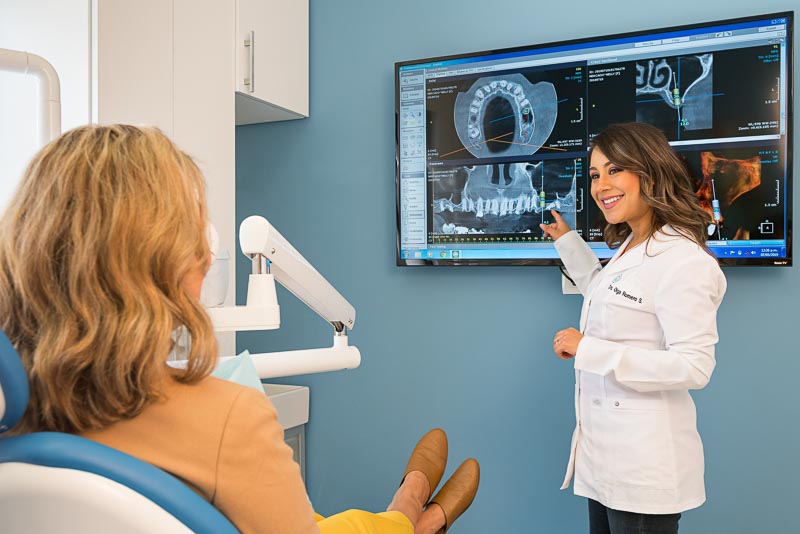
CBCT analysis is essential. The doctor should evaluate bone volume and quality, sinus and nerve position, ridge shape, available anterior-posterior spread, angulation options, and the amount of restorative space. The condition of the remaining dentition, infection, parafunction, smoking, systemic disease, medications, and ability to tolerate surgery must also be considered. Patient expectations should be realistic, and the patient must understand provisional and definitive treatment stages.
A key point is that not every full-arch patient should automatically receive exactly four implants. All-on-4 is one treatment concept within the broader field of full-arch implant rehabilitation. The final implant number and distribution should be based on anatomy, stability, biomechanics, and the restorative plan rather than on a fixed formula.
In SOTA Dental’s Clinical Excellence Program, Dr. Nestor Marquez, the lead training doctor, teaches participants how to evaluate real cases before entering surgery. Doctors review patient CBCT scans, discuss risks and surgical options, and rehearse possible approaches on 3D-printed models. Dr. Nestor Marquez emphasizes the clinical judgment behind patient selection, not just the mechanics of implant placement.
Dentists who want to improve their All-on-4 patient-selection and treatment-planning skills through real-patient mentorship can apply for the Clinical Excellence Program with Dr. Nestor Marquez at https://sotadental.com/doctors-clinical-excellence-program/.